Loading...


Diamond Anatomy
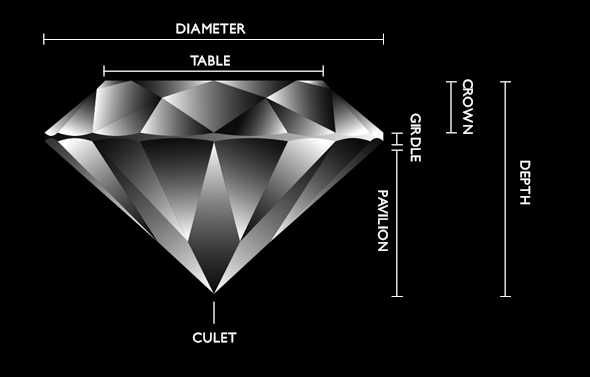
The "anatomy of a diamond" refers to the different parts or structural features that make up a cut and polished diamond.
Understanding these parts helps with evaluating a diamond’s proportions, brilliance, and overall appearance.
Here’s a breakdown of the key components:
Table
The large, flat top facet of the diamond. It’s the largest facet and allows light into the diamond.
Crown
The top portion of the diamond above the girdle, extending from the table to the girdle. It includes the star, bezel (or kite), and upper girdle facets.
Girdle
The thin perimeter or edge dividing the crown and pavilion. It’s where the diamond is typically held in place by a setting. It can be faceted, polished, or rough. Its also where you will find the serial number of a certified stone.
Facet
The flat surfaces on a diamond cut for light reflection and refraction. A standard round brilliant diamond typically has 57 or 58 facets.
Pavillion
The lower portion of the diamond, below the girdle, extending to the culet. It's responsible for the diamond’s sparkle by reflecting light back through the crown.
Culet
The tiny facet (or point) at the very bottom of the diamond. A large culet can be visible through the table and may affect the diamond’s brilliance.
Depth
The total height of the diamond from the table to the culet.
Diameter
The width of the diamond measured at the girdle.


Telephone & Text 07703 697983
studio@abbevilleau.com


Registered in England 16310193
AbbevilleAU is the trading style of CAVU Design Ltd
© 2026 - CAVU Design Ltd