Loading...


UK Hallmarking
Hallmarking is a legal requirement for most precious metal jewellery sold in the UK.
These official stamps certify the metal’s authenticity and purity, and indicate where and when the item was tested. However, not all genuine rings carry hallmarks. Before the 1973 Hallmarking Act, it was common for UK rings particularly lightweight, imported, or handmade pieces to be sold without them.
Even when present, hallmarks can wear away over time or be lost entirely during resizing or repairs. Marks that fall along the band where a ring is cut for adjustment are especially vulnerable. That’s why jewellers often rely on additional methods such as acid testing, XRF analysis, and stylistic evaluation when appraising antique or unmarked rings.
Precious metals are rarely used in their pure form, as they are too soft. Gold, silver, platinum and palladium are generally mixed (alloyed) with copper or other metals to create an alloy that is more suitable to the requirements of the jeweller or silversmith. The hallmark indicates the amount of precious metal in the alloy in parts per thousand (the millesimal fineness). In addition to indicating the town where the item was marked, a unique sponsor’s or maker’s mark identifies the item’s origin and a date letter to represents the year of marking.
All of our products come with a guarantee of the precious metal content through the 700-year-old practice of third party independent hallmarking.
This is a quality control mark placed on gold, silver and platinum and it's a safeguard for purchasers. Basically, the hallmark shows that it has been tested by an independent body (at the Assay Office) and guarantees that the metal is of one the legal standards of fineness (purity).
A hallmark also lets your jeweller quickly check what carat your jewellery is if you have to take it in for repairs or alterations. It is a legal requirement for most articles of precious metal above a certain minimum weight to carry an approved hallmark.
The British hallmark is made up of at least 3 compulsory symbols:
The Sponsor's Mark
This indicates the manufacturer, or sponsor of the item. This consists of the initials of the company who sent in the item for assaying.
The Fineness Mark
This indicates what the metal is and its standard of purity in parts per thousand.
The Assay Office Mark
This identifies the Assay Office at which the item was tested and marked.

The Goldsmiths’ Company Assay Office in London (also known as Assay Office London or the London Assay Office) is the oldest assay office in the United Kingdom.
The company has provided hallmarking services since the Goldsmiths’ Company was founded in the 1300s.
The company received its royal charter in 1327 and ranks 5th in order of precedence of the 12 Great Livery Companies of the City of London.

Hallmarking dates back to the 1300s, when Edward I of England passed a law requiring any item made of silver and offered for sale to be at least of equal quality as that of the coin of the realm (silver currency).
The four wardens of the Goldsmiths’ Company were tasked with visiting workshops in the City of London to assay (test) silver articles.
If these articles were found to be below standard they were originally forfeit to the King, but if they passed, each article received the King’s mark of authentication which was the mark of a leopard’s head. By 1478, there were several hundred workshops and merchants manufacturing silver articles in the City of London. It was not possible for the wardens to visit them all, and so the merchants were ordered to bring their items to Goldsmiths’ Hall for testing and marking, with a permanent Assay Office being established in the building.
This is the origin of the term hallmark – struck with the King’s mark at the Goldsmiths’ Hall.
In 1544, the Goldsmith’s Company adopted the King’s mark as their town mark, and the mark of the leopard’s head is now internationally recognised as the mark of this assay office.
In the UK it is illegal to sell or describe any item as Gold, Silver, Platinum or Palladium unless it is hallmarked.
A hallmark applied by a UK Assay Office is not proof of origin or place of manufacture of an item.
The hallmark of a UK Assay Office (whether applied by a UK Assay Office in its approved locations in or outside the UK) is proof that an item (in all its parts) is of the standard of fineness indicated by the hallmark struck on that item.
Hallmarks applied by UK Assay Offices at their approved locations within the UK are clearly differentiated from those applied by UK Assay Offices in their approved locations outside of the UK (as detailed in the table below).
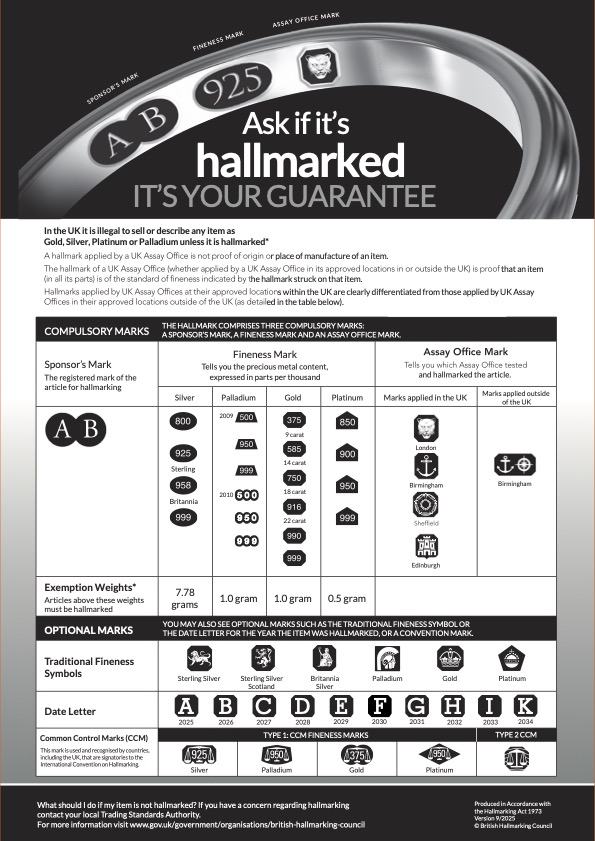
Hallmark Guide Supplied by the London Assay Office
Hallmarking FAQ
What do the symbols or stamps inside my ring mean?
Hallmarks are official UK stamps that certify the metal’s fineness, the assay office where it was tested, and the year it was hallmarked.
Why does my ring have stamps on it?
In the UK, hallmarking is a legal requirement for most jewellery made from precious metals. These small stamps offer reassurance by proving your piece is genuine and meets strict purity standards.
My gold ring has no hallmark - does that mean it's fake?
Not all genuine rings have hallmarks. Pieces made before the 1973 Hallmarking Act, or those under historic weight limits, were often exempt. And over the years, hallmarks can wear away or disappear entirely during resizing or restoration work.
Do antique rings always have hallmarks?
Prior to 1973, many UK rings particularly lightweight, imported, or handmade pieces were legally sold without hallmarks. As a result, jewellers often rely on supplementary techniques such as acid testing, XRF analysis, and stylistic assessment to authenticate antique rings.
What does the Leopard symbol mean on a ring?
The Leopard stamp shows your jewellery was tested at the London Assay Office.
What does 585 mean on gold?
"585" indicates 14 carat gold - 58.5% pure - See chart above this section for more.
What does 925 mean on a piece?
"925" indicates sterling silver (92.5 % silver) - See chart above this section for more.
What does "PLAT" or "PT" mean?
Both abbreviations represent platinum and may appear alongside a fineness mark, typically 950 indicating 95% platinum content.
Can resizing remove hallmarks?
Yes. Hallmarks that are positioned where a ring is cut for resizing can be partially or completely lost. We will always try to preserve hallmarks when resizing.


Telephone & Text 07703 697983
studio@abbevilleau.com


Registered in England 16310193
AbbevilleAU is the trading style of CAVU Design Ltd
© 2026 - CAVU Design Ltd