Loading...


What is Gold?
When you hold a piece of gold, you’re holding the ashes of stars that lived and died long before our Sun was even born.
Those atoms were forged in cataclysms so violent that they shook space itself, stars collapsing, neutron stars colliding, galaxies lit by the flash of creation. The universe scattered those fragments into the dark, and for billions of years they drifted, waiting.
Then, 4.5 billion years ago, they fell together into the dust cloud that became our Solar System, our planet, and eventually us.
When you wear gold, you are wearing a relic of ancient stars, a thread of eternity woven into the fabric of Earth.
How is Gold made?
Gold is made through processes that happen in some of the most violent and energetic events in the universe.
Gold is not formed in normal stellar fusion (like how stars make helium from hydrogen). Instead, it’s created during cataclysmic stellar events such as Neutron Star Mergers
When two neutron stars collide, they produce an explosion called a kilonova. These collisions release enormous amounts of energy and free neutrons.
Neutron stars collide when two of them are in a binary system, orbiting each other and gradually spiral inward due to the emission of gravitational waves.
Binary neutron stars are rare, but not impossibly so and their mergers are even rarer. Only 20 confirmed BNS systems have been found in our entire galaxy.
In this environment, rapid neutron capture (r-process) occurs, building up heavy elements like gold, platinum, and uranium. Recent observations (like the 2017 detection of gravitational waves from a neutron star merger) confirmed this as a major source of cosmic gold.
Of course, this begs the question, what is a Neutron Star? In short, a neutron star is formed when a star collapses, they are small, approximately 20 KM wide but incredibly dense.
In short, That means you're squeezing more than a Sun's worth of mass into a sphere the size of a city… This makes neutron stars some of the densest objects in the universe. A sugar-cube-sized amount of neutron star material would weigh about a billion tons on Earth!
After being forged in space, gold atoms are blasted into interstellar space. Over billions of years, some of this material ends up in new stars, planets, and asteroids.
All the gold on Earth, including the gold in your jewellery, likely came from collisions of dead stars billions of years ago, before the Earth even existed.
It is at least 4.6 billion years old, and much of it could be billions of years older, formed in the ancient deaths of stars that long predated our Sun. When you wear gold, you're literally wearing the product of cosmic violence from long before the solar system was born.
How old and how far?
Most of the gold in the universe was likely created during violent events such as neutron star collisions (and possibly some rare supernovae). The famous 2017 neutron star merger observation, GW170817, confirmed that these collisions produce heavy elements like gold and platinum.
The gold on Earth did not come from one single nearby collision. Instead:
Gold atoms were forged in one or more neutron star mergers billions of years before the Solar System formed.
Those atoms spread through interstellar space as dust and gas.
Eventually they became part of the giant molecular cloud that collapsed to form the Sun, Earth and the other planets about 4.6 billion years ago.
So the distance traveled is enormous and not precisely traceable for any specific atom of gold. A typical estimate is:
Thousands to millions of light-years through the Milky Way over billions of years.
Some gold atoms in your jewellery may have originated:
On the opposite side of the Milky Way,
From mergers that happened before the Sun even existed,
Then drifted through multiple generations of stars before ending up on Earth.
For scale:
The Milky Way is about 100,000 light-years across.
Heavy elements can circulate through the galaxy many times before being incorporated into new stars and planets.
So a gold atom on Earth may have traveled:
Tens of thousands of light-years spatially, and
Billions of years temporally before reaching Earth.
Neutron star mergers produce a particular type of GRB (gamma-ray burst), the most powerful class of explosions in the cosmos. They create near-light-speed jets that emit gamma rays, powerful ripples in space-time called gravitational waves, and a so-called kilonova explosion that forges heavy elements like gold and platinum. So far, only one event, observed in 2017, has connected all three phenomena.
Animation Credit: NASA’s Goddard Space Flight Center
Music: “A Theory Develops,” Pip Heywood [PRS], Universal Production Music
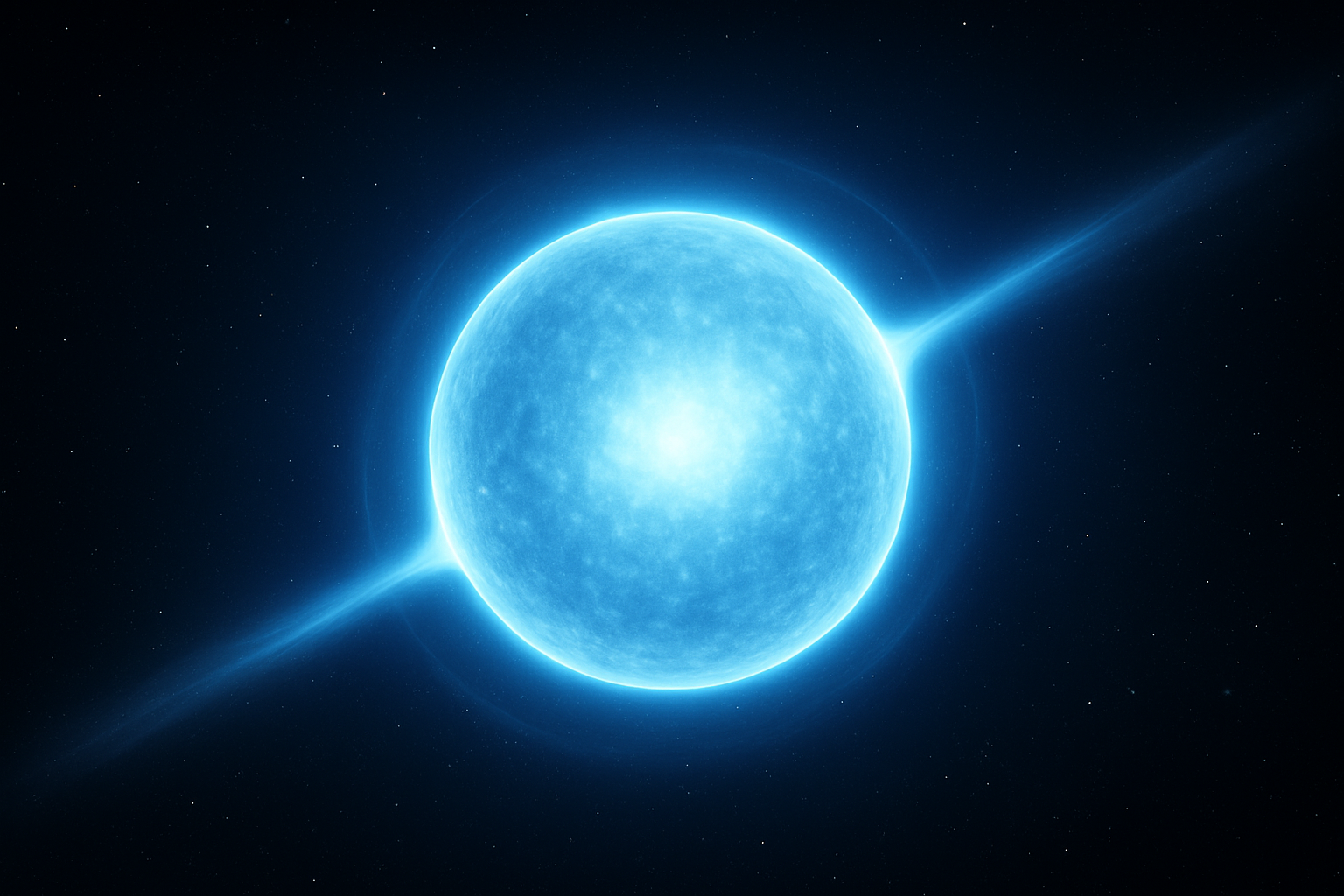
A neutron star
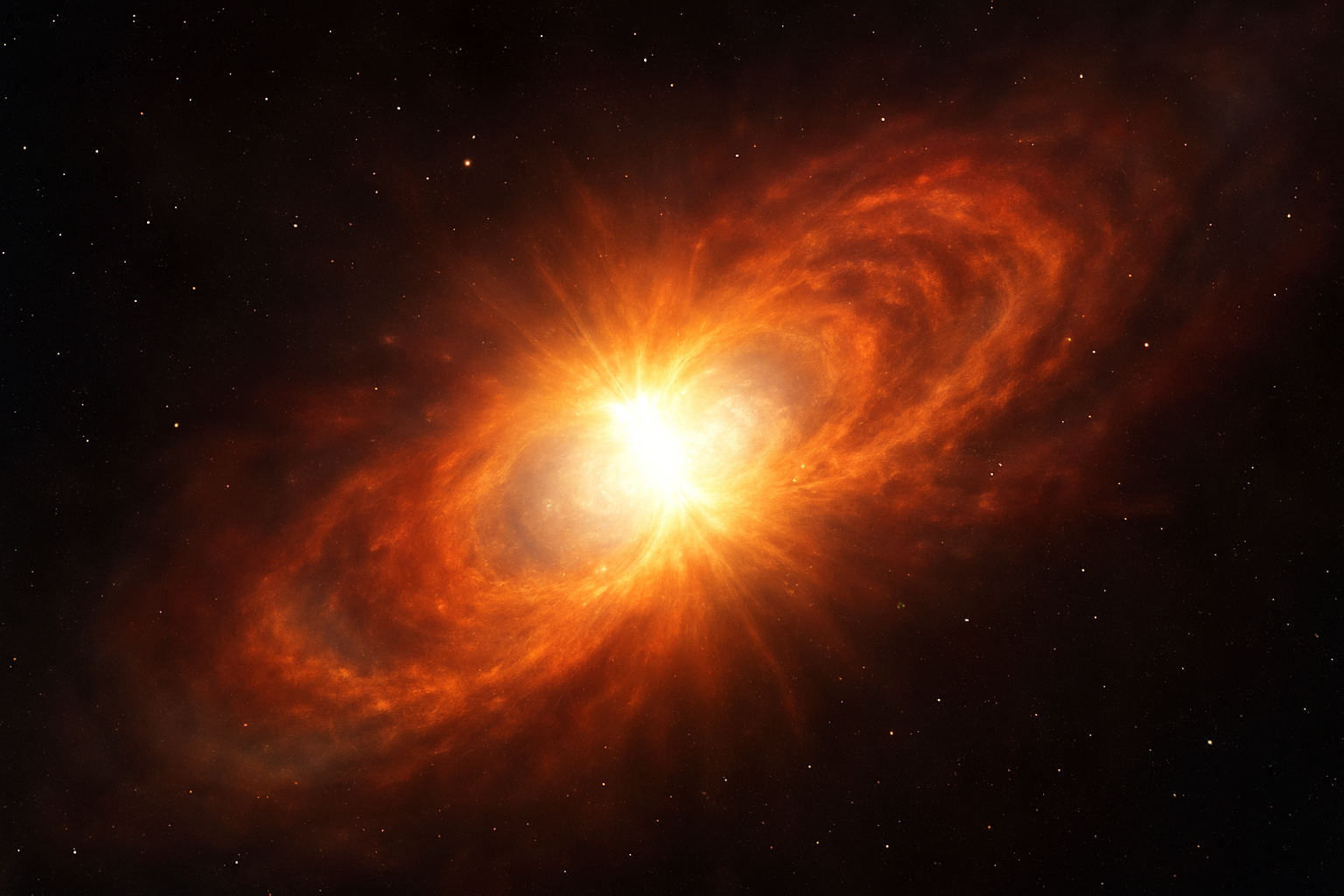
What a neutron star collision might look like to the eye
The yellow colour of gold is caused by absorbing violet and blue light, but reflecting yellow and red light.
Pure gold is combined or 'alloyed' with other metals to add strength, and hardness.
The amount and type of other materials (alloys) added determines the final carat (gold content) of the gold alloy.
18k gold is composed of 75% gold, which is alloyed with other metals, normally copper to make it strong enough for everyday use.
The chemical symbol of gold is Au. This symbol comes from the Latin word "aurum," which means shining dawn. Gold’s atomic number is 79 on the periodic table.
What's the difference between 9 carat and 18 carat gold?
The principal difference is the precious metal content. 9 carat gold contains 37.5% pure gold. 18 carat gold contains 75% pure gold.
The remainder is an alloy of various metals, which may include copper, zinc, silver, palladium or platinum, depending on its intended colour - ie yellow, rose or white.
9 carat is harder than 18 carat gold, it resists scratching well and was traditionally used for such items as watch cases
A 18 carat gold item will generally be more expensive than its equivalent in 9 carat gold as it contains double the amount of pure gold.
it is strong, beautiful, durable and does not tarnish, corrode or react with the skin.
24 carat gold is gold in its purest form and consists of 99.9% gold. It is naturally yellow and extremely valuable, but also soft and malleable, so not usually used to make fine jewellery.
See our guide to UK Hallmarking here.
White Gold
White gold is an alloy made by mixing pure yellow gold with white-coloured metals (like palladium, nickel, or silver) to give it a silvery-white appearance. It’s popular as a modern alternative to platinum.
Gold is naturally yellow, so the white metals dilute the yellow tone, giving it a pale colour. However, white gold is not perfectly white on its own. That’s why most white gold pieces are rhodium-plated.
Rhodium is a rare and precious element that can be 10 to 25 times more expensive than gold. Rhodium is a member of the platinum group of metals and is silver-hued, highly reflective and does not tarnish or corrode. It is harder than gold and is highly durable.
See notes on Rhodium below.
Rose Gold
Rose gold is made by alloying pure gold with copper (and sometimes a bit of silver). This process changes both the colour and physical properties of the gold, making it stronger and giving it its distinctive pinkish hue.
Rose gold is not found naturally; it’s created through alloying: Pure gold (24k) – soft and yellow in colour. Copper – provides strength and the reddish colour. Silver (optional) – used to soften the red tone and improve malleability.
Rose gold originated in early 19th-century Russia, where it was known as "Russian gold" and popularised by famed jeweller Carl Fabergé in his Fabergé Eggs.
Rose gold is stronger and more scratch-resistant than yellow or white gold of the same karat due to copper. Over time, rose gold may darken slightly or develop a warm patina, which enhances its vintage look.
Gold Vermeil
Gold vermeil, or just vermeil, is a term used to refer to jewellery or other items made of silver and coated with gold. The word “vermeil” comes from the French and is pronounced “ver-may.” Vermeil jewellery is made by first creating the base of the item in silver and then plating it with a layer of gold. This method is called electrolysis.
The essential difference between vermeil and gold-plated jewellery is that vermeil items have a base made of silver, whereas plated and filled pieces can be made with a variety of base metals such as bronze. For this reason, vermeil jewellery is generally more valuable than comparable gold-plated items.
See Gold Plating


Telephone & Text 07703 697983
studio@abbevilleau.com


Registered in England 16310193
AbbevilleAU is the trading style of CAVU Design Ltd
© 2026 - CAVU Design Ltd