Loading...


Eternity Ring
Resize & Repair - Notes for Guidance.
Eternity rings require special care when resizing. Here are some of the considerations.
Gemstones go all the way around
Unlike a standard ring (which often has a plain section of metal at the back), an eternity ring is set with stones around the entire circumference. This leaves no empty metal area to cut, stretch, or compress.
Disrupting the pattern
If you add or remove metal to resize, the continuous pattern of stones is broken. To keep symmetry, you’d often need to add or remove stones, which is much more complex than a simple resize.
Stone settings at risk
Cutting into the band can weaken or misalign the settings, making stones loose or prone to falling out.
Fragile stones
Diamonds are durable, but many eternity rings use other gemstones (like emeralds, sapphires, or rubies) that can chip or crack under heat or pressure during resizing.
Thin bands
Eternity rings are usually quite delicate. Attempting to stretch or compress the metal can distort the setting or compromise the ring’s structural integrity.
Because of all this, resizing often requires either: Rebuilding the ring with more or fewer stones, or making a completely new ring in the correct size. We are happy to advise.
Resizing Methods
Sizing Beads or Liners (for minor downsizing)
Instead of cutting the band, we can add small beads (or a thin liner) inside the ring.
This slightly reduces the inner circumference.
Advantage: No disruption to the stones.
Limitation: Only works for going down about ¼ - ½ of a size.
Adding or Removing a Stone (for major resizing)
To make the ring larger, we may add one or more stones and extra metal.
To make it smaller, they may remove a stone and close the gap.
Advantage: Keeps the “full eternity” look.
Limitation: Requires sourcing matching stones in size, cut, and quality, which can be very expensive and sometimes impossible.
Rebuilding the Shank
We cut the band and rebuild part of it with either stones or plain metal.
Example: Some eternity rings can be converted into 3/4 eternity rings, with a small plain section hidden at the back allowing resizing flexibility in future.
Advantage: Long-term solution.
Limitation: Changes the design from a true eternity ring.
Remaking the Ring Entirely
If the size difference is significant (more than 1 size up or down), often the only safe option is to remake the whole ring in the correct size, re-using the original stones.
Advantage: Perfect fit, secure settings.
Limitation: Costly, essentially like commissioning a new ring.
Setting Styles
Here’s a breakdown of eternity ring setting styles and how they affect resizing difficulty:
Easiest to Resize (relatively speaking)
Channel set (half-eternity only)
Stones are set in a groove between two strips of metal. If the ring is a full eternity, resizing is still very difficult — but if it’s a half-eternity, the plain back gives room for adjustment.
Prong/Claw set (half-eternity)
Like the channel setting, a half-eternity version leaves space at the back for resizing.
Hard to Resize
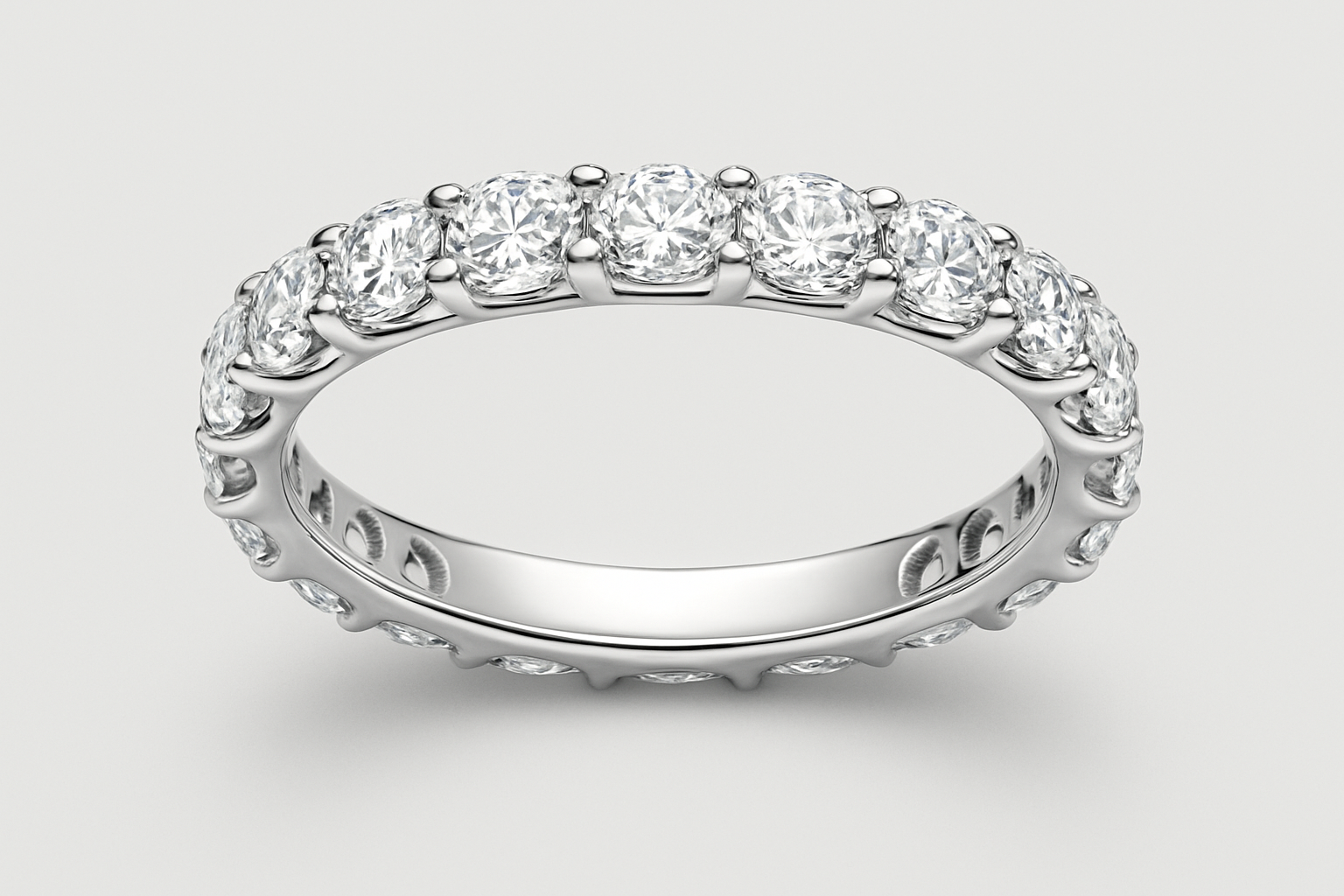
Shared prong full-eternity (like the one in the image above)
Every stone shares a claw with the next. Cutting the band risks loosening multiple stones. To resize, usually a stone must be added/removed, or the ring rebuilt.
Bezel set full-eternity
Each stone is fully enclosed in a metal rim. That makes adjusting the size extremely tricky without re-making the entire ring, since the bezels are rigid.
Hard to Resize Pt.2
Pavé full-eternity
Tiny stones cover the entire band. Any cutting or stretching breaks the pattern, and the tiny settings can collapse. Usually requires complete remanufacturing.
Channel set full-eternity
The channel runs continuously around the band, locking all stones in place. There’s nowhere to cut safely. Resizing can mean remaking the ring.


Telephone & Text 07703 697983
studio@abbevilleau.com


Registered in England 16310193
AbbevilleAU is the trading style of CAVU Design Ltd
© 2026 - CAVU Design Ltd